


John F. Wilcox: From Timber to Torque
Lake Minnetonka’s Industrial Visionary
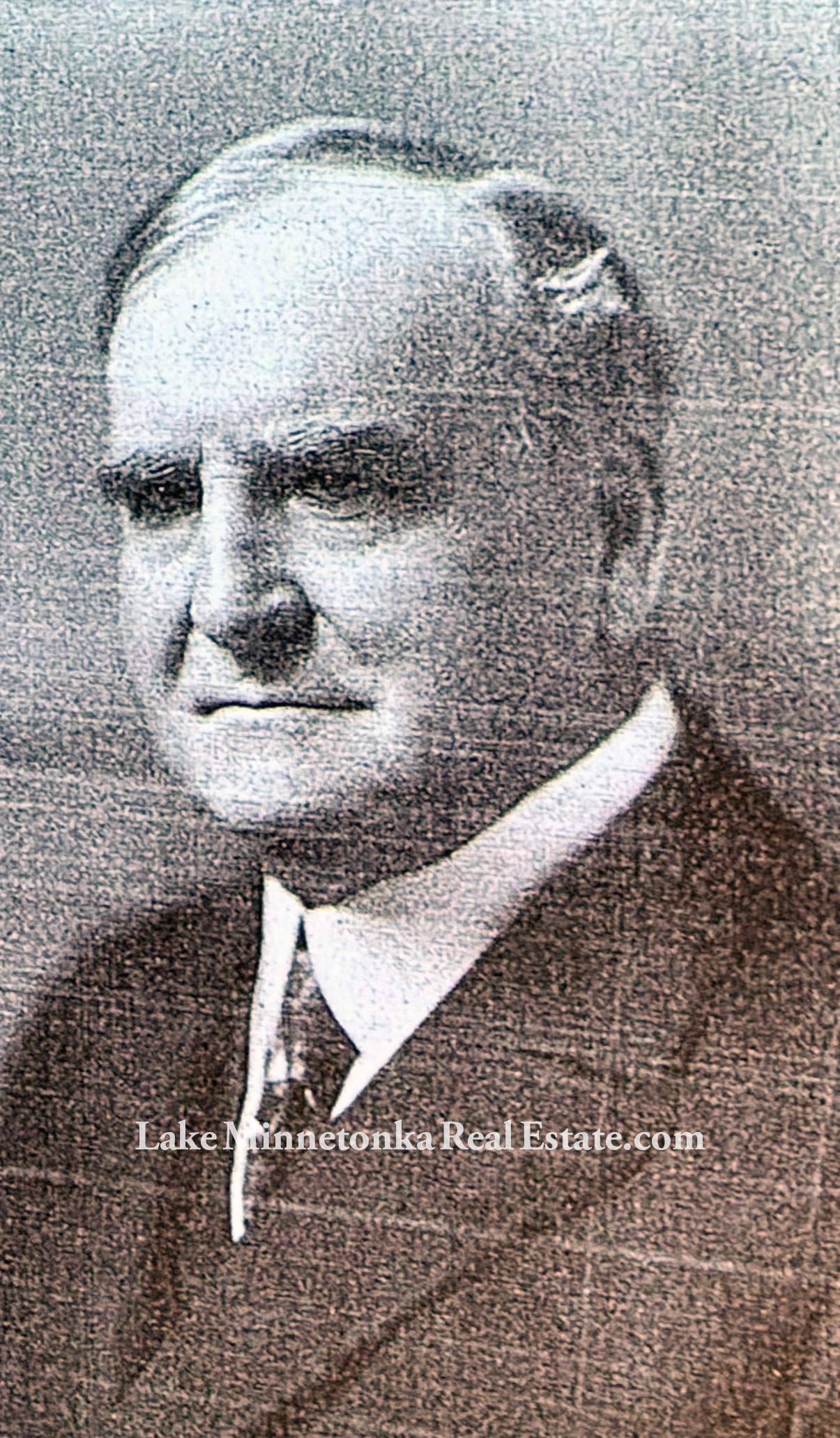
When the mills along the Mississippi still scented the city with fresh-cut pine, John Finley Wilcox arrived from Ohio with an instinct for timber and an eye for scale.
Born in Akron, Ohio in 1847, and educated at Granville College, John Finley Wilcox arrived in Minneapolis in 1867 — part of the first wave of industrialists who would transform the young city from sawmill settlement to manufacturing center.
Interestingly, 1867 was the same year the railroad reached Wayzata.
The Timber Years — Craftsmanship at Scale
After apprenticing with Wheaton Reynolds & Francis, a sash-and-door firm in Minneapolis, Wilcox struck out on his own in 1885 and founded the J. F. Wilcox Company.
The first plant stood on the east bank of the Mississippi, a modest shop turning raw lumber into fine millwork — paneled doors, window sash, stair parts, and trim that defined the architectural character of the Upper Midwest.
Then, in 1893, fire swept through the building — a common fate in that age of open flames and sawdust.
Rather than retreat, Wilcox rebuilt bigger.
His new complex rose at 1030 Marshall Street Northeast, a two-and-a-half-block industrial campus fronting the river.
It became one of the largest sash-and-door factories in Minnesota, employing more than 225 men at its height and shipping finished millwork by rail across the region.
The hum of planers and band-saws inside its brick walls echoed the optimism of a city being built in real time.
That site remains part of Minneapolis’s industrial heart.
For nearly a century, the property housed Graco Inc., the fluid-handling manufacturer whose headquarters still stand at the intersection of the Broadway Avenue Bridge and the Mississippi River, a short walk from the historic Grain Belt Brewery.
Graco recently announced a move to Rogers, marking the end of more than 100 years of continuous industry on the very ground John Wilcox first developed.
Few places in Minneapolis illustrate so clearly the lineage from the lumber boom to modern manufacturing.
From Timber to Torque — The Wilcox Motor Companies
By 1900, Wilcox’s sons were ready to trade sawdust for steel.
Encouraged by his mechanically minded eldest, Harry E. Wilcox, the family invested lumber profits into a new venture: the Wilcox Motor Car Company, later known as Wilcox Trux.
Their first automobiles — the short-lived Wolf Car line (1906–1909) — gave way to hand-built Wilcox cars and trucks that supplied breweries, hardware distributors, and utilities across Minneapolis.
Harry had a gift for spectacle: he once borrowed a circus elephant to ride in the bed of a Wilcox truck through downtown, advertising its strength.
By the 1910s, the company’s delivery wagons and haulers had replaced horse teams for firms like Grain Belt Brewery, Minnesota Gas, and Warner Hardware.
In 1924 the Wilcox name appeared again — this time on the side of Wayzata’s first motorized fire engine, a gleaming red machine that still exists today, restored as a civic heirloom.
Personal & Family
-
Wife: Emma E. Clement (daughter of Andrew and Emily Clement, originally of Massachusetts and New Hampshire).
-
Children:
-
Harry E. Wilcox – President, Wilcox Motor Car Company
-
Archie Wilcox – Physician and surgeon, Minneapolis
-
Myrtice (Wilcox) Joslin – Married Dr. Walter T. Joslin, dentist
-
Ralph D. Wilcox – President, John F. Wilcox Sash & Door Company
-
Beatrice (Wilcox) Keator – Married Clark L. Keator of Barber Milling Company
-
Civic & Personal Character Notes
Though quietly ambitious, Wilcox embodied the civic conscience of early Minneapolis. A lifelong Republican and Consistory Mason, he supported local improvement projects but preferred to lead by example rather than office. He attended Plymouth Congregational Church, held membership in the city’s leading clubs, and was remembered as both an exacting craftsman and a devoted family man. His summers were spent refining his Lake Minnetonka retreat at Crescent Beach — later expanded into the estate known as Old Orchard — where industry met repose.
The Estate on the Orchard Hill
Success in timber and transportation found its expression in land.
In 1896, after years of spending summers on Tonka Bay at Crescent Beach, Wilcox purchased the former State Fruit Farm from the University of Minnesota — 86 acres of rolling orchard between Gideon’s Bay and Birch Bluff — and built Old Orchard, a stately lakeside retreat. The University the purchased the property that is the home of the modern day Arboretum.
Gardens, pergolas, and a four-story water tower crowned the property, blending practical ingenuity with pastoral calm.
It was a place built by a craftsman who understood both joinery and legacy.
Legacy
When John F. Wilcox died in 1918, his name had become shorthand for quality — whether etched into door casings in Minneapolis or cast into radiators on the trucks that bore it.
His rebuilt factory still anchors the industrial memory of Northeast; his estate, Old Orchard, anchors the cultural memory of Lake Minnetonka.
Together they tell a single story: that craftsmanship, when paired with imagination, can build not just homes or machines, but an enduring sense of place.