


Chapter 3 – Value of Lake Minnetonka
An assessment of the monetary value of Lake Minnetonka to the general public and to private interests is presented in the following pages. However, as the dominant water feature of the western metropolitan area, the lake also provides many values which cannot be evaluated in monetary terms. For example, communities adjacent to or near the lake are provided with a sense of identity, form, and structure based upon an outstanding scenic resource. The sense of pride that many people in the Minneapolis-St. Paul area have for the metropolitan environment is enhanced by the presence of this large body of water within a few miles of the urban area. Moreover, participation in outdoor recreation at the lake, whether it be swimming, boating or simply sightseeing, contributes to the mental and physical well-being of the individual and, therefore, of the entire community.
There are some lake related values which can be approximated in monetary terms. These include the recreation and scenic benefits which accrue to residents of the lake area, and'the recreation benefits obtained by non-residents who participate in such activities as swimming, fishing and boating on the lake. The former benefit can be determined from the willingness of people to pay for land near the lake. Accordingly, the resident, or private, benefit is reflected in the difference in land value between land adjacent to the lake and land at some distance from the lake. The non-resident, or public, benefit can be estimated from information on the number of people using public and commercial recreation facilities at the lake.
The quantification of lake related values, insofar as possible, is an important aspect of the Lake Minnetonka study for a number of reasons. An estimate of the private and public lake associated benefits provides an order of magnitude estimate of the values that will be protected by a pollution abatement program. If the value is significant, abatement projects involving the expenditure of considerable sums of money may be clearly justified. However, if the lake benefits are insignificant, a low priority for the improvement program may be warranted.
Quantified information on values will also be of assistance in allocating the costs of improvement programs to the different beneficiaries. Also, the process of measuring benefits, when possible, is important in itself. The process imposes a discipline upon the planner and decision maker wherein the correct questions are asked and the most important elements of the problem are recognized.
A description of the outdoor recreation opportunities available to the public and an assessment of their value is presented in the first section below. This is followed by a section describing the measurement of the increased value, attributable to the lake, of residential land on and near the lake. The final section presents the economic framework for the analysis of pollution abatement investments, and discusses some of the limitations of this study.
Public Value of the Lake
Public Use of the Lake
Swimming, pleasure boating, and fishing are the primary recreation activities pursued at Lake Minnetonka. Existing swimming beaches are used, for the most part, by residents of the lake area. Public boat launching ramps and private marinas supply access and boating facilities to the resident and non-resident public. Existing public beaches and commercial and public boating facilities are described briefly below.
In addition to the public and commercial facilities, there are, of course, a great many private facilities along the lakeshore utilized by individual land owners. However, benefits that accrue from private lakeshore facilities are reflected in the value of lakeshore property.
Swimmers
There are eight reasonably well-developed public beaches along the Lake Minnetonka shoreline. They are listed in Table 111-1. Also given are the approximate size of the beach area and an estimate of the beach capacity in users assuming a requirement of 50 square feet per person.
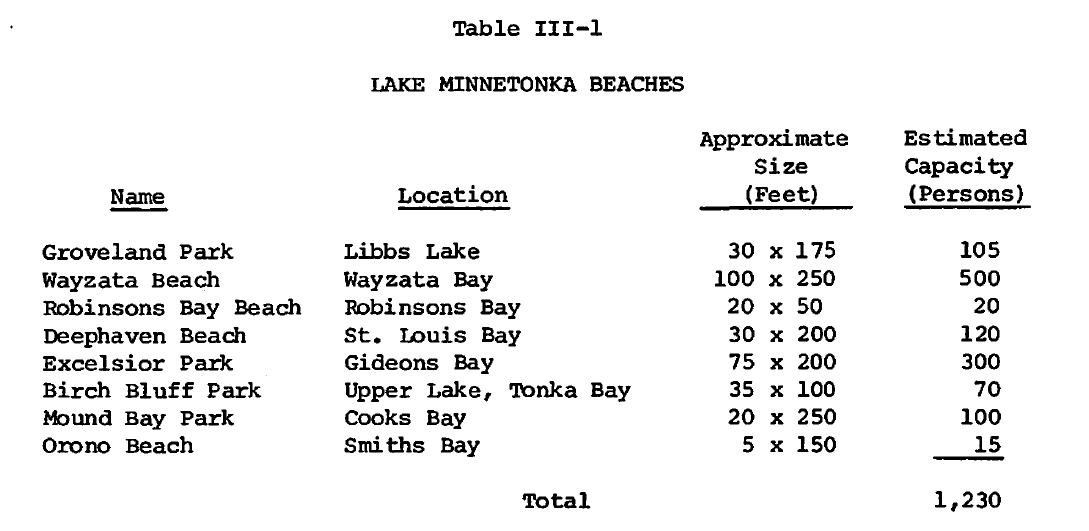
About 40 percent of the total beach area is located at Wayzata Beach. This is a village-owned facility requiring permits to use the parking area. As a result, most users are from the Village of Wayzata. The other sizable facility is located in Excelsior. Permits to use the parking area near the beach are not required. However, non-residents are required to pay 10 cents per hour at local parking meters. Residents of Excelsior with permits are allowed to park free. Although some users of the beach are non-residents, it is estimated that most users are residents of Excelsior or nearby areas. The remaining beaches have a relatively limited capacity. Users of these facilities are, for the most part, from the Lake Minnetonka area.
Use by Boaters
In 1969, there were 23 commercial boat rental and docking facilities located on the lake. They are listed in Table 111-2 along with the number of boats berthed, stored, and rented. A total of 1,341 boats were berthed at marinas in the summer of 1969, and 168 boats were available for rental. Many of the marinas have launching ramps and limited space available for car and boat trailer parking. Existing yacht clubs and the number of boats at each club are also listed in Table III-2. Most of the boats berthed at yacht clubs are sailboats. Public boat launching facilities with concrete ramps are available at six locations. These are listed in Table III-3. The approximate car and trailer parking capacity is also shown. Grays Bay, Spring Park, and Hendricksons are owned and operated by Hennepin County. The other three facilities are owned by the villages within which they are located. car and trailer parking at Wayzata beach and Parkway Beach is by permit only. Thus, use of these two facilities is essentially restricted to residents of Wayzata and Deephaven, respectively.
Table III-3
PUBLIC BOAT LAUNCHING FACILITIES AT LAKE MINNETONKA
Grays Bay / Grays Bay - 45 Parking Capacity
Spring Park / Spring Park Bay - 80 Parking Capacity
Hendricksons / North Arm - 75 Parking Capacity
Wayzata Beach / Wayzata Bay - 0 Parking Capacity
Parkway / St. Louis Bay - 0 Parking Capacity
Cottagewood / Carsons Bay - 20 Parking Capacity
Parking Capacity is in Car and Trailers
In 1970 the Lake Minnetonka Conservation District found 287 sailboats and 2,241 boats of other kinds at marinas, yacht clubs, and other berthing facilities around the lake. Of 2,241 boats, at least 128 were berthed at docks belonging to apartments. Recreation value for the boats docked at apartments will be reflected in the rent the individual is willing to pay for the apartment, and therefore, in the value of the land.
Hence, it can be concluded that about 2,100 boats were in use in 1970 by people who were not residing on the lakeshore. The Conservation District also surveyed the facilities available for launching boats. It found that in 1970 there were 28 ramps accessible to the public with a total of nearly 800 parking places for cars and trailers available.
Use by Fishermen
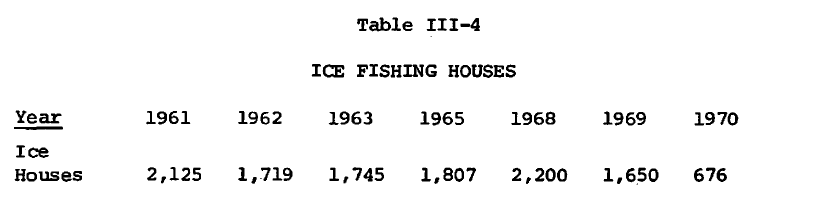
Information is unavailable on the amount of resident and non-resident fishing that takes place from boats. Information on actual numbers of shoreline fishermen is also unavailable. However, a cursory examination of Lake Minnetonka on a summer Sunday indicates that shoreline fishing is a popular activity. Hennepin County has supplied sanitation facilities at the Narrows Bridge area in order to accommodate the increasing number of fishing enthusiasts along the Narrows. Data indicating the amount of winter fishing that takes place on the lake is available. Icehouse counts were recorded for eight years during the period 1961 to 1970. The average number of icehouses per year was 1,690.
Public Value
Public benefits result from participation in lake-oriented recreation activities by people who do not reside adjacent to the lake. It is common policy in the United States to credit recreation facilities with a benefit ranging from $0.50 to $1.50 per visitor day of recreation participation at the facility depending upon the quality of the experience. This is the range in values adopted as u.s. Government standards in Senate Document 97, dated 1964. The higher values are generally assigned to water related recreation Where a variety of activities are possible while lower values are assigned to such activities as picnicking and hiking. If the annual number of non-resident visitor days to Lake Minnetonka was known, the public benefit could be readily estimated, but, unfortunately, few user counts have been made at Lake Minnetonka. The remainder of this section describes assumptions used in estimating the number of annual visitors from the data available.
As indicated in the above review of existing facilities, the primary activities that non-residents participate in are boating and fishing. swimming facilities are used mainly by residents, and picnicking and camping facilities are almost non-existent.
Value to Boaters
Non-resident boaters gain access to the lake from commercial marinas and yacht clubs and public launching ramps. Assuming that three-fourths of the sailboats at yacht clubs and the boats berthed and rented at marinas are used on a typical summer Sunday by non-residents, a total of 1,790 boat ~ys perS.Wlday_ may be credited to the public account. Further, assuming that the ramps granting public access are used to capacity and that the turnover on a summer Sunday is 2.0, a total of 1,600 boat days per Sunday are obtained. Once the Sunday participation is known, the following simple formula, developed by the Bureau of Outdoor Recreation, may be used to estimate the annual visitation.
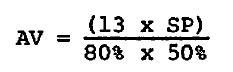
where:
AV = Annual participation
SP = Sunday participation
13 = Number of weeks in summer recreation season in northern United States
80% = Percent of annual visitations that will occur in the peak recreation season.
50% = Percent of weekly visitations that occur on Sunday.
Surveys of park users in other parts of the united States have generally found that 40 to 60 percent of the weekly visitation to a park facility occurs on Sunday. The mid-point of this range, or 50 percent, has been adopted for use in this study. Other terms and numbers used in the formula are self-explanatory. On the basis of the formula, annual non-resident use is about 110,000 boat days, or assuming three users per boat, 330,000 user days. If the net benefit is $1.00 per visitor day, the annual boating benefit is $330,000.
Value to Fishermen
The available information on fishing use is less adequate. Counts of participants in summer shore fishing, such as at the Narrows, have not been made. The only data that is available refers to ice fishing. Average number of icehouses on the lake for eight years during the period 1961 to 1970 was 1,690. Assuming that each icehouse is used. by two persons, and that 75 percent are non-residents, the winter Sunday participation in icehouse fishing amounts to 2,540 visitor days. If winter fishing without icehouses is equally great, total Sunday participation is 5,080 visitor days.
Assuming that the ice fishing season is 13 weeks long, the above annual visitation fonnula may be applied unchanged. Based on the formula, the annual visitation is 165,100 user days. At a net benefit of $1.00 per visitor day, the annual winter fishing benefit is say $165,000.
Summary
The non-resident benefit for boating and ice fishing amounts to $495,000 per year. At an interest rate of 6 percent, the present worth of $495,000 in benefits for 50 years is $7.80 million. It is estimated that the benefit total may be as high as $9.0 million when an allowance is made for non-resident Shore fishing, and any nonresident swimming, picnicking, and pleasure driving participation.
It is apparent that the capacity of the lake for public recreation is far greater than its present public access and public facilities can support. If adequate public park area, including facilities for picnicking, swimming, and boating were provided, public recreation participation could be raised· to over one million visitor days annually without taxing the capacity of the water area. Corresponding public recreation benefits could easily exceed $20 million, present worth.
The calculations are, of course, approximate. Nevertheless, the assumptions and analysis should be sufficiently accurate to provide a benefit total which is of the correct order of magnitude.
Private Value of Lake
Many people have.a preference for land on or near a lakeshore, and are willing to pay additional sums of money to satisfy this preference. The increase in the value of land due to its proximity to a waterfront is one measure of the value of a lake. Thus, a determination of the resident or private value of Lake Minnetonka necessarily involves a survey of land values on or near the shoreline o The value of land near a body of water is, of course, influenced by a number of factors in addition to distance to the shoreline.
Among the most important of these factors are slope, drainage, existence of utilities, and location of the parcel relative to population centers, alternative lake opportunities, and the transportation network. The problem is one of isolating the effects of the distance from the lake variable from the effects of the other determinants of value. That is, distance from the lake accounts for an unknown increment in land values. In addition, other factors such as distance from Minneapolis and the slope of the land account for increases or decreases in value. The objective of the analysis is to fully define the effect of all variables and, in this way, to identify and separate out the effect of the lake on property values.
The land value data used in the analysis represents the 1970 assessed valuation of individual parcels as deter.mined for county tax purposes. Prior to the statistical computations, it was assumed that land values Up to one mile from Lake Minnetonka may be influenced by the presence of the lake. Based on this judgment, it was decided to sample property values at the lakefront and at distances of one-quarter, one-half, and one mile from the shoreline. By a random selection procedure, 110 parcels were selected for inclusion in the sample set. Only areas where it was possible to obtain a sampling depth of one mile from the shoreline were included in the population from which the sample was selected. Consequently, Mound, Spring Park, and Minnetonka Beach are not represented in the sample. These areas were, however, included in the calculations to determine the total lake induced value, as described below.
The value and area of each sample parcel was recorded and the market value per acre was calculated. The range in values was from $9,750 for a 50 x 70 foot shoreline parcel in Wayzata, or the equivalent of about $120,000 per acre, to zero private value for parcels in public use. i'he average values at each distance zone from the lake are shown in Table III-S. As indicated in the table, land values are substantially higher at the lakeshore, after which they diminish rapidly up to a distance of one-half mile. At greater distances than one-half mile, land values are apparently unaffected by distance from the shore.
Table III-5
AVERAGE LAND VALUES AT VARYING DISTANCES FROM LAKE MINNETONKA
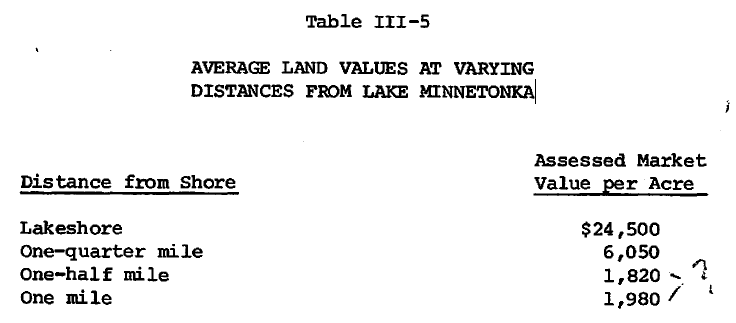
The higher value at one mile than at one-half mile does not necessarily indicate that land at one mile has a greater value than land nearer the shore. Rather, given the small size of the sample, it only indicates that the means at one-half mile and at one mile are not significantly different.
Since land values at a distance of one mile appear not to be greatly influenced by the lake, observations at one mile were dropped from the analysis. In addition, since the analysis is to determine private land values, public land observations included in the data, such as school property, were also eliminated. The final sample size included 77 observations of private land values.
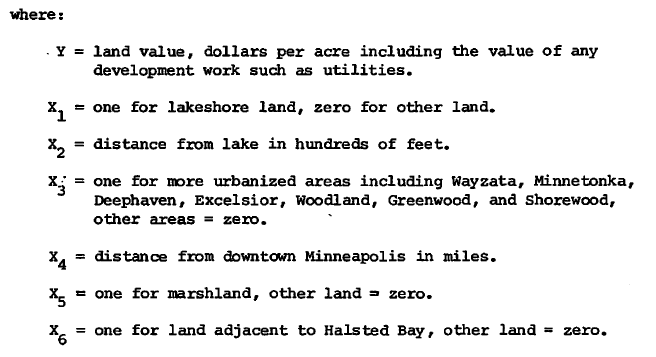
A multiple regression analysis was used in this study to determine the effect on land values of the various explanatory variables. The mathematical and statistical procedures used are described in detail in Appendix A. The observations were coded for computer analysis and a number of alternative regressions were generated using land value per acre as the dependent variable and the following as possible explanatory variables:
- Whether land is located on lakeshore.
- Distance from lake.
- Whether or not area is urban.
- Distance from Minneapolis.
- Whether land is dry or marshy.
- Whether or not land is adjacent to Halsted Bay.
This variable represented an attempt to identify the effect of greater populations of algae in Halsted Bay. The equation found was:

Estimates of the value of land were made for all land up to one-half mile from the lakeshore. Areas excluded in the sample population (such as Mound and Tonka Bay) were included in this analysis. All land around the lake was partitioned into tracts according to distance from the lakeshore and distance from Minneapolis. Areas of marsh within each tract were delineated, and the d%yland and marshland acreage by tract was determined. Land values per acre for each tract were estimated by means of the regression equation, and the value attributable to the lake was determined by subtracting the value per acre at one-half mile from values per acre for sections nearer the shoreline. Finally, the total lake induced value of a tract was established by multiplying the incremental values per acre by the wet and dry acreage totals within the tract.
An example calculation may help to clarify the procedure. Assume that the incremental value due to the lake is to be estimated for a section of the lakeshore which is 12 miles from Minneapolis. From the equation, the value of dl:y, lakeshore land in an urban area is about $35,000 per acre at a distance of 12 miles. Similarly, the equation predicts a value of land at one-half mile from the lakeshore and 12 miles from Minneapolis of $4,400 per acre. The value per acre attributable to the lake is the difference between the two values, or $30,600 per acre. Assuming that the average lakeshore parcel is 200 feet deep, the area of a one mile tract of shoreline is about 24 acres. Thus, the incremental value of a mile of shoreline at an average distance os 12 miles is 24 times $30,600, or $734,000. This process is repeated for all land tracts within one-half mile of the shoreline to obtain the total effect of the lake on property values.
Based upon the foregoing analysis and computations, the gross incremental effect of Lake Minnetonka on land values is estimated to be $46.3 million. If an allowance of 33 percent is made for land in public uses and streets, the net value of Lake Minnetonka, as reflected in incremental private land values, is $31 million. This value does not include a reflection of the incremental value of Lake Minnetonka as reflected by the homes or other improvements to the land.
It appears reasonable to conclude that in addition to the affect of Lake Minnetonka on land values, the improvements on the land are more valuable than improvements on land remote from the lake. For comparison purposes, it is noteworthy that the total appraised value of land and improvements to land in the 155 square miles comprising the Lake Minnetonka Conservation District is nearly $650,000,000. This area is not exactly the same as the watershed for the Lake, but provides a good basis for comparison.
Economic Analysis
The previous two sections have described the analysis leading to the determination of the public and private value of the lake. The private value is about $31 million, and the estimated public benefit is $9.0 million. Total present value, aside from the intangible lake-related benefits noted in the first section, is say $40 million.
As the demand for lakeshore land increases in the future, due to increasing incomes and metropolitan population, it is likely that land values around Lake Minnetonka will increase. In addition, public benefits will increase if additional public recreation facilities are constructed on the lakeshore. The 1968 State outdoor recreation plan prepared by the Minnesota Department of Conservation indicates that in the future there will be a substantial need for additional water-oriented recreation facilities in the metropolitan area. Boating, fishing, and swimming facilities constructed on Lake Minnetonka would help to meet the need, and would raise the public benefit total that accrues to the lake.
The estimated present monetary value provides a benchmark to which proposed pollution abatement investments may be compared. The estimation of the value of the resource does not, however, provide adequate guidance to establish the economic feasibility of possible future investments to protect the resource. An economic study to determine the highest and best use of Lake Minnetonka requires an appraisal of the consequences of utilizing the lake for various alternative purposes. At the present time, Lake Minnetonka is utilized both as a water recreation resource, and as a receiving area for treated wastewater. One alternative for the future would be to continue to use the lake in the present fashion. Benefits would accrue from using the lake to diffuse and neutralize wastewater, and from its value as a recreation resource. It is probable that the recreation benefits, as reflected in land values and visitation, would diminish with time as populations of algae increase. It can be said that the value of the lake as a waste receiver is equal to the minimum cost of eliminating the damaging effects of the effluent.
Lake Minnetonka may also be used as a single purpose recreation lake. In this alternative, the wastewater would be diverted away from the lake or subjected to advanced waste treatment and, as a result, populations of algae would be lower than in the first alternative. Future land values and public recreation benefits would be somewhat higher due to a reduction in algal blooms. The cost information for the economic appraisal of whether or not to undertake the abatement program is relatively easy to obtain. It is simply the investment cost plus operation and maintenance cost of diversion or advanced treatment facilities. It would be desirable, if possible, to also express the benefits in monetary terms so that they could be directly compared with the costs. Since the water uses affected are recreational and esthetic in character, difficulties are experienced in achieving this goal. It is impossible to forecast the extent to which land values and recreation benefits will diminish with time if the lake continues to be used as presently, or the amount by which these same benefits will increase if the function of diffusing treated wastewater is eliminated.
The regression analysis completed previously suggests that algal blooms in Halsted Bay may have affected adjacent land values. Land around the bay was reduced in value by about 50 percent, or from $870,000 to $420,000. This implies that if algae populations in the bay were reduced to at least the average concentration in the remainder of the lake, a benefit of about $450,000 would accrue from land value enhancement. However, as indicated above, there is some doubt as to whether or not the lower land values around Halsted Bay are due to pollution of the bay. Other factors such as assessment bias or transportation may be responsible for the negative coefficient in the equation. A more extensive study involving a greater sample size would be necessary in order to eliminate the uncertainties connected with this variable.
In summary, as a result of the analysis, the tangible value of Lake Minnetonka is estimated to be about $40 million. In addition to the tangible benefits, the lake provides a number of intangible benefits which cannot be evaluated in monetary terms. It appears that continued degradation of the water quality would further reduce property values, and would also have an effect upon public recreation participation on the lake.