


Chapter 4 Nutrient Budget
Introduction
The increasing enrichment of surface waters has resulted in serious water quality problems due to excessive production of aquatic plants. Manis activities have had a great effect in altering the natural environment. Urbanization, discharge of sewage, and certain agricultural practices have increased the amounts of nutrients present in our lakes and rivers. When the concentrations of these materials become too high, excessive growths of aquatic plants may reduce the waters desirability for domestic, recreational, and industrial uses.
Watershed management plans for controlling the growth of aquatic plants - those rooted on the bottom, those which float, and the microscopic algae - in lakes must be properly designed in order to be effective and economical. There is no single solution for saving all lakes. A pollution abatement program adequate for one lake may be totally inadequate in watersheds with different land use patterns and nutrient sources.
Previous studies (Report on Bacteriological and Chemical Sampling of Lake Minnetonka 1966-67 for League of Lake Minnetonka Municipalities prepared by Schoell and Madson, Incorporated, Hopkins, Minnesota) have assumed that phosphorus may be the most significant nutrient related to biological productivity. Research conducted for this study by the Limnological Research Center of the University of Minnesota affirms that phosphorus is the critical factor that controls growth of algae in Lake Minnetonka during the months when algae grow to nuisance levels. Since the introduction of phosphorus to the lake lends itself to evaluation, at least some of the sources may be controlled. Therefore, a phosphorus budget has been prepared.
Sources of Phosphorus
One of the major sources of phosphorus to the waters of Lake Minnetonka is the effluent of the wastewater treatment plants in the watershed. (Report on Bacteriological and Chemical Sampling of Lake Minnetonka 1966-67 for League of Lake Minnetonka Municipalities prepared by Schoell and Madson, Incorporated, Hopkins, Minnesota) Schoell and Madson estimated that 80% of the phosphorus and 30% of the nitrogen between June, 1966 and July, 1967 were from sewage effluent. This study indicates that 30.7/50.3 = 61 % of the phosphorus entering the lake in 1969-1970 was contained in the effluents of wastewater treatment plants.
The second greatest source of phosphorus is from runoff from land within the watershed. Studies in Tulsa, Oklahoma, (Storm Water Pollution from Urban Land Activity by AVCO Economic Systems Corporation; FWQA Report No. 11034 FKL 07.70) Cincinnati, Ohio, (Urban Land Runoff as a Factor In stream pollution by S. R. Weibel, R. J. Anderson, and R. L. Woodward, Journal water Pollution Control Federation Volume 35 p. 914, July 1964) and Toronto, Ontario (Significance of Some Factors Affecting yields of Phosphorus from Several Lake Ontario watersheds by G. E. Owen and M. G. Johnson, Proceedings of the Ninth Conference on Great Lakes Research, P. 400) indicate that approximately 510 pounds of phosphorus per year are contained in the runoff from one square mile of urban land (0.8 value is 4-5 times greater than that for phosphorus runoff from rural and agricultural lands.)
Studies by Holt (Runoff and Sediment as Nutrient Sources by R. F. Holt in 1969 Annual Conservation Society of America; published as Minnesota Water Resources Research Center Bulletin 13) and by Timmons, Burwell, and Holt in Minnesota, and Owen and Johnson (Loss of Crop Nutrients Through Runoff by D. R. Timmons, R. E. Barwell, and R. F. Holt in Minnesota Science Volume 24, No.4, Summer 1968) near Toronto, Ontario, indicate that approximately 130 pounds of phosphorus per year are contained in runoff from rural and agricultural land (0.2 lb./acre/year). This value varies somewhat depending on the cover crop and agricultural practices, but is a good approximation as long as extensive amounts of manure are not applied to frozen ground. Other sources of phosphorus entering the lake include rainfall (on the lake surface only), ground water, individual soil absorption sewage disposal systems, and recreational activities conducted directly on the lake.
Quantities of Phosphorus
Gaging stations
Gaging stations were established at 18 locations on tributaries of Lake Minnetonka and the outlet of the lake, Minnehaha Creek. Periodically, the flow at these gaging stations was determined and analyses of the nutrient concentrations were made.
In the region around Lake Minnetonka, many small streams such as the tributaries to the lake freeze solid during the winter months. similarly, the ground surfaces are frozen, and no runoff to the streams occurs during those months. Because of the great affinity of soil particles for the phosphate ion, much of the phosphorus which runs off of land surfaces is probably carried adsorbed to soil particles. Since the capacity of a stream to carry sediment (soil particles) is proportional to between the flow squared and the flow cubed it was hypothesized that the greatest nutrient flow into the lake would occur at times of peak runoff. Furthermore, in streams which have pronounced runoff peaks, the greatest portion of the total nutrients contributed to the lake during a year may well be carried on those few days during the year when the flow is at a maxim
Accordingly, no fixed interval was established for sampling these streams, but an attempt was made to sample them during their peak runoff periods. Several of these stations were located on streams which carried effluent from wastewater treatment plants as well as runoff from rural or urban land.
In order to assess the relative importance of land runoff and treatment plant effluent as sources of phosphorus for the lake, it was necessary to compare the amounts discharged by the treatment plants and the amounts estimated to runoff from land surfaces with the amounts sampled at the gaging stations. The basis for these comparisons is discussed below.
Wastewater Treatment Plants
Flow records for the six largest of the seven wastewater treatment plants emptying into the watershed were published in the Interim Report. Phosphorus determinations were made on weekly grab samples of treated effluent collected at each plant so that total phosphorus released during the twelve month period June, 1969 to May, 1970 could be determined. Carefully controlled daily composite samples were also collected for a oneweek period to verify the adequacy of the grab samples. Estimated D monthly flows based on population served were utilized to determine phosphorus output from the Victoria wastewater treatment plant since no flow data were available.
Land Runoff
Phosphorus contributions from land runoff were estimated on the basis of 130 pounds of phosphorus per square mile from upland rural or agricultural land, and 510 pounds per square mile of urban land. 17.5 square miles of urban land (at 510 lbs. P/sq. mi.) drained directly into the lake without passing through a gaging station. Only negligible amounts on non-urban land drained into the lake without passing a gaging station.
Other Sources
Rainwater
Phosphorus derived from treatment plants and from land runoff accounts for more than 84% of the estimated total amount entering the lake each year. Precipitation directly on the lake surface contributes additional nutrients that have been flushed out of the atmosphere. Studies of the phosphorus content of rainwater have yielded results varying from 0.01 to 0.09 mg/l. Since more values were found in the low range, a value of 0.02 mg/l of phosphorus was used for this study. The average annual rainfall was taken as 28.9 inches on the 21.5 square mile surface of the lake. This resulted in an average annual phosphorus contribution of 1,800 pounds (815 kg) per year to the lake.
Recreation
An estimated 270,000 visitor days of recreational activity occur on the lake each year including ice-fishing, warm-weather fishing, boating, and swimming activities. Physiologists report that up to 1.B g of phosphorus per day per person is excreted in urine and 1.0 in feces. If it is assumed that 10% of the recreationists release 1/4 of their daily urine to the lake, and 1% defecate, approximately 31 pounds of phosphorus per year would be added to the lake from these sources. These sources present a greater danger from the standpoint of bacterial contamination than as a source of nutrients.
Septic Tanks
soil absorption sewage disposal systems at homes and cottages in the watershed also serve as sources of nutrients. While this type of system has the advantage of generally trapping the nutrients by ion exchange on soil particles, a certain amount may still reach the lake by movement through the soil or by direct overflow of improperly functioning systems. The phosphorus contributions from this source were estimated by the water Subcommittee of the Natural Resources Committee of State Agencies for the State of Wisconsin in a report dated January 31, 1967 to be 0.2 lbs./cap/yr. reaching natural watercourses. This quantity was adopted for the studies of Lake Mendota near Madison, Wisconsin and has been used for this study. Since only half of the 45,000 persons in the watershed were connected to treatment plant facilities, it is assumed the other half were using septic tanks. Thus, approximately 22,500 x 0.2 = 4,500 pounds per year would be added from this source.
Septic Tank Pumpage
During the study year it was observed that the pump age from septic tanks was occasionally improperly discharged to watercourses leading directly to Lake Minnetonka. Prompt steps were taken to alleviate this situation. Because the relatively small size of the treatment plants within the watershed made it difficult to receive the septic tank pumpage without upsetting or overloading the plants, arrangements were made for the receipt of the pumpage by a larger plant under the aegis of the Metropolitan Sewer Board.
Based on the number of tank truck loads being received under this program, it was estimated that 30,000 to 40,000 gallons per day were being pumped out of septic tanks during the study. For a year around average, 30,000 gallons per day were assumed.
During the field survey of the treatment plants in the watershed, samples of the pumpage from septic tanks were analyzed on two occasions. Analyses of these samples were reported in the Interim Report under the Mound Spring Park Wastewater Plant Survey. The complete reports are repeated in Table IV-I which follows.
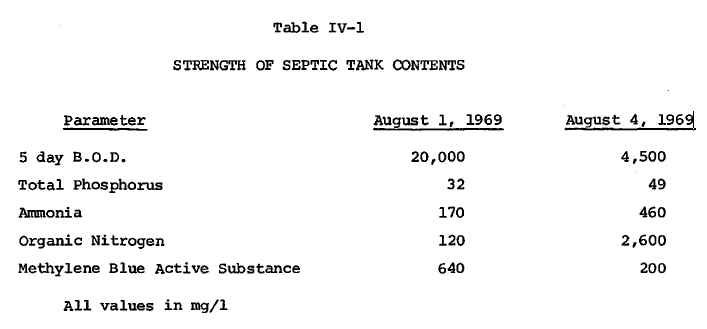
For estimating the nutrient input to the lake due to improper disposal of septic tank pumpage, it was assumed that the concentration of phosphorus averages 40 mg/l. Forty mg/l is approximately four times the concentration fOWld in the effluent of treatment plants in the watershed during the study period.
From the wastewater treatment plant survey, it was estimated that during the study an average of 4 to 10 septic tank trucks were discharged daily at one treatment plant for a total volume of 6,000 to 15,000 gallons. Therefore out of a total of some 30,000 gallons pumped out of septic tanks each day of the year, one-half may have been disposed of improperly and entered the lake. The phosphorus which might have been added to the lake during the study year would be 15,000 gallons x 365 days @ 40 mg/l ; 1,800 pounds per year.
While additions of pump age phosphorus containing phosphorus could have an adverse impact on the lake, the major damage caused by illicit unloading of septic tank pump age will be in the immediate vicinity of the point of discharge. Gross pollution may occur due to floating materials. The phosphorus concentration is about 4 times the phosphorus concentration of treatment plant effluent, but the biochemical oxygen demand is 150 to nearly 700 times as strong as the effluent from a treatment plant. septic tank pump age will not have received any form of disinfection prior to discharge and the presence of suspended and dissolved organic materials would make any attempt at disinfection of questionable value. Therefore, the proper disposal of the pump age from septic tanks must be continued as long as they are used. The septic tank pumpage cannot be received by the relatively small treatment plants because the shock loading of BOD would upset the operation of the plants.
Others
Phosphorus may also be contributed to and taken from the lake by the movement of ground water. Since data are not available to determine the net migration of ground water in the vicinity of the lake, a net value was not assigned for this factor in the nutrient budget. There are additional sources that may contribute phosphorus to the watershed and lake, but they have not been evaluated in this study since no data exist on which an estimate of their relative contributions could be based. These sources include, among others, wetland drainage and leaching of nutrients from bottom sediments in the lake. However, the available evidence indicates that averaged over the entire Lake, the sediments remove phosphorus from the Lake on an annual basis.
Phosphorus Losses
The amount of phosphorus deposited in the bottom sediments cannot be calculated directly. Research by the Limnological Research Center of the University of Minnesota indicates that on an annual basis phosphorus is removed from the lake in excess of the amount leaving at Grays Bay. It is presumed that this is adsorbed by the bottom sediments.
Other avenues of phosphorus removal include removal of fish from the lake and outflow at Grays Bay Dam. On a net weight basis, fish are reported to contain 0.2% phosphorus. (Biological Associated Problems in Freshwater Environments, by V K. M. Mackenthun and W. M.Ingram, U. S. Government Printing Office, 1967) Since approximately 60,000 pounds of rough fish (carp, bullheads, dogfish, etc.) are removed annually (Unpublished data of the Minnesota Department of Conservation) and an estimated 200,000 pounds of fish are caught by fishermen, (Quoted by J. B. Moyle in a memorandum on Wildlife Values of Lake Minnetonka) approximately 500 pounds (230 kg) of phosphorus per year are removed from the lake in this manner.
The data collected on outflow from the lake, together with the phosphorus concentrations of the outflow at the time the flow measurements were made, indicated that approximately 30 pounds (15 kg) of phosphorus flowed out of the lake and down Minnehaha Creek during the study year. During an average year, water usually overflows during the months of May, June and July, and amounts to 8 inches of water on the lake. The concentration of phosphorus reported by E.A. Hickok and Associates for this study (Interim Report) during those months of 1969-1970 was .050 mg/l.
Schoell and Madson (Report on Bacteriological and Chemical Sampling of Lake Minnetonka 1966-1967 for League of Lake Minnetonka Muncipalities prepared by Schoell and Madson, Incorporated, Hopkins, Minnesota) sampled both in Grays Bay and Minnehaha Creek. Neglecting their highest single phosphorus concentration, the remaining phosphorus concentrations reported average about 0.120 mg/l in these months of 1966-1967. It was assumed that in an average year the phosphorus concentration would be 0.85 mg/l, from which the phosphorus loss is found to be 1000 kg or 2200 lbs. annually.
Determination of Phosphorus Budgets
Present Conditions
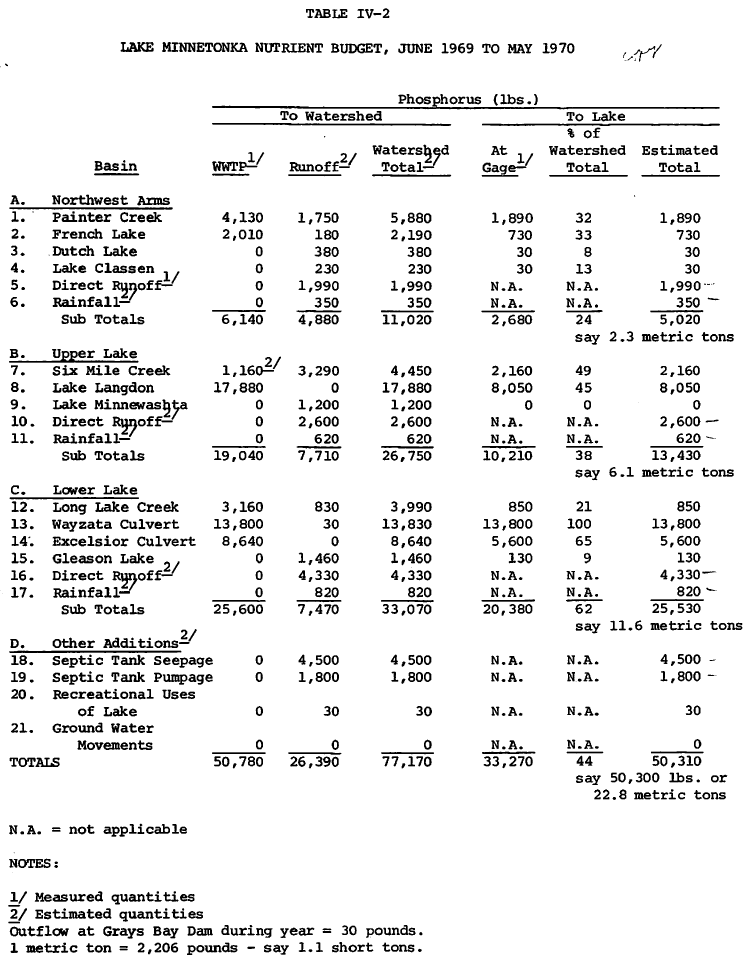
Contributions calculated for each sub-watershed of the basin for the period June, 1969 to May,' 1970 are presented in Table IV-2 (page IV-12). Painter Creek, for example, flows into Lake Minnetonka at Jennings Bay in the northwest portion of the lake. Periodic streamflow and phosphorus concentrations were taken at the point where the creek goes under a road just before it enters Jennings Bay. Flows ranged from a high of 34.7 cfs in late April to 0 cfs during the fall and winter. Phosphorus concentrations ranged from 0.740 to 0.200 mg/l.
The Maple Plain Wastewater Treatment Plant is located 2 to 3 miles upstream from the mouth of the creek. The stabilization pond at the treatment plant drains into a swampy area and then to Painter Creek. The creek itself flows through and drains a mixture of agricultural and marshy areas. The watershed upstream from the gaging station contains 13.5 square miles.
It was determined that the discharge from the Maple Plain Wastewater Treatment Plant amounted to approximately 80 million gallons between June, 1969 and May, 1970. The phosphorus content amounted to approximately 4,130 pounds. In addition, an estimated 1,750 pounds of phosphorus (13.5 sq. mi. x 130 lbs./sq. mi.) were contained in runoff from the watershed. Thus, almost 5,880 pounds were released to the watershed during the year.
Measurements at the gaging station indicate an annual flow of approximately 590 million gallons to the lake. This flow carried with it an estimated 1,890 pounds of phosphorus. Thus, 3,990 pounds of phosphorus (5,880-1,890), or 68 percent, appear to have been removed from the water of the creek before it entered the lake. Similarly, greater or lesser proportions of phosphorus were removed from the other tributaries depending on the presence or absence, size, and location of wastewater treatment plants. Where no plant emptied into the tributary, approximately 90 percent of the phosphorus derived from runoff was removed before it reached the gaging station.
The amount of phosphorus discharged to the watershed by the wastewater treatment plants is known on the basis of the weekly grab samples collected at the plants. Measurement of phosphorus reaching the lake from three of the plants, however, are less comprehensive than hoped for. Unfortunately, these are the three largest plants (Mound-Spring Park, Wayzata, and Excelsior). Because there is no continuous record of flow available for the spring runoff, it must be taken on faith that the peak flows were measured.
Since these Observations reflect phosphorus lost in sediments to plants and in marshy areas, they are important. However, they reflect flow and phosphorus concentration for periods of about 40 days out of the year. April 20-May 26 = 37 days for Excelsior, April 7-May 26 = 50 days for Mound-Spring Park, and April 24-May 26 = 33 days for Wayzata.
From these short records, total phosphorus flux was computed and compared with the phosphorus flux from the wastewater treatment plants for the same pe~iod of time. It was assumed that the same percentage of removal occurs during the entire year.
There are many faults with this assumption. Among the more Obvious are:
- precipitation Influences. April and May are characterized by rainfall in amounts greater than the immediately preceding months, and the spring thaw frequently occurs in early April. Therefore, the phosphorus washed in from surrounding lands may be in excess of the yearly average, and the flows of water in the streams may re-entrain previously deposited sediment with adsorbed phosphorus to a greater extent at this time of the year than at other times of the year. April and May 1970 had precipitation which was nearly twice the normal for those months.
- Temperature Influences. The freezing months of the winters in Minnesota apparently tend to rupture the cells of plant material (such as grass stems, leaves) allowing the nutrients within to escape, at the same time also holding all these nutrients in place until the spring thaw occurs. This material may have runoff before the stream measurements were made.
Low temperatures also reduce the energy transfer rates within treatment plants and thereby reduce the need for phosphorus and the efficiency of phosphorus removal. This is dramatically revealed in the grab samples collected by the Pollution Control Agency during the entire year at the outlet of these plants. Typical are those for Long Lake where phosphorus was measured at around 5 mg/l during the summer but around 10 mg/l during the winter; or the discharge of the effluent pond at the Mound-Spring Park plant where phosphorus was measured in the same 5 summer to 10 winter range. It is reasonable to expect that the same lowering of removal efficiency occurs in the swamps and streams between the plants and the lake.
- Continuity of Flow. The flow measurements indicate that Lake Langdon's outlet was frozen solid on April 7, 1970. The record does not indicate even approximately when the lake first ceased to discharge. No information is available as to the disposition of the wastes entering Lake Langdon during that period when it had no discharge.
It is believed that the greater removals expected during the summer months will offset the lesser removals expected during the winter and that the results found during April-May will therefore be representative of the overall removal.
At the Wayzata plant, nearly twice the phosphorus was measured at the culvert between April 24 and May 26 as was released from the plant during the same period of time. On a comparable basis, approximately 65% of that released from the Excelsior plant entered the lake and 45% of that from the Mound-Spring Park plant. The greater apparent proportion of phosphorus entering the lake from the Wayzata wastewater treatment plant as compared to the others seems to have been influenced by the location of the gaging station at Wayzata. Whereas there were good locations for gages adjacent to the lake at the other plant s"ites, none was available at Wayzata. Accordingly, the gages for the other plants were downstream of marshes, while Wayzata's was not. In addition, a riding stable is located a short distance upstream of the Wayzata gage. without more information to go on it is speculation to try to estimate the distribution between the plant, the stable, and the removal which may well occur in the marsh. For an annual average of all effects, it was assumed that 100% of the phosphorus released by the plant reached the lake.
Phosphorus inputs from direct rainfall on the lake and urban runoff were discussed in the previous section. Boundaries of sub-basins were established by the locations established for gaging stations. The inputs from each sub-basin were added together to obtain basin values and the total input to the lake.
Discussion
It can be seen from Table IV-2 that approximately 77,000 pounds of phosphorus were estimated to be released to the watershed during the study year. About 66 percent of this phosphorus was derived from wastewater treatment plants. Direct runoff to the lake, esentially from w::ban areas, was estimated to be 8,920 pounds, about 12% of the watershed total. Annual phosphorus input to the lake itself was estimated at 50,300 pounds (22.8 metric tons). The remainder was retained in the lakes, marshes, and swamps tributary to the main body of the lake. It has been assumed that the retained phosphorus is permanently trapped. However, there is no proof of this and it may be flushed into the lake at some later time.
During the study year, phosphorus was being removed from the lake by a variety of means. Loss over Grays Bay Dam amounted to approximately 80 million gallons and only 33 pounds of phosphorus for the year. Although rainfall in tne watershed during the study period was approximately normal, flow out of Lake Minnetonka appeared to be below normal. Flow over the dam usually occurs for at least three months of the year, but was limited to only two months during the present study. Likewise, flows in most tributary creeks were limited to two months, and there was no flow from Lake Minnewashta to Lake Minnetonka. Flow from Lake minnewashta normally occurs approximately one year in four.
With increased urbanization of the watershed, greater amounts of the rainfall will run off into the lake and tributaries because of an increase. in the amount of impervious area. This increased runoff would tend to extend the period of time flow would be expected over the dam. This increased flow into and out of the lake would have only minimal effects, however, on the phosphorus budget. Since increases due to increased urbanization can be considered separately, the only increase in phosphorus input would be a greater flushing action in the tributaries, thereby causing more of the phosphorus in the watershed to be carried to the lake. Such increases would be relatively minor in contrast to the total annual phosphorus input. Likewise, increased flow over the dam, with phosphorus concentrations typical of that portion of the lake, would not remove significant amounts of phosphorus from the lake.
It has previously been noted that approximately 500 pounds of phosphorus per year are removed from the lake in the harvest of fish and 3,080 pounds during normal outflow over the dam. In all, approximately 3,600 pounds, or about 7% of the present annual input of 50,300 pounds of phosphorus, is physically removed from the lake during an average year. The remaining phosphorus in the lake and/or watershed is either available as nutrient or found in vegetation and bottom deposits.
Effects of Increased Urbanization
Phosphorus Load. By the year 2,000 it is estimated that an additional 27 square miles of land in the watershed will become urbanized. Total population is estimated at 146,000. It was assumed that all of this additional urbanized area is presently rural uplands (approximate phosphorus runoff from urban areas - 510 lbs./mi; from rural areas - 130 lb./mi) and drainage from the area will flow directly to lake. Therefore, an additional 10,300 pounds of phosphorus per year will be added to Lake Minnetonka as a result of the increased urbanization. {510 x (130 x 27) = 10,260}
Of the present population of about 46,000 people, approximately one-half or 23,000 people are served by the wastewater treatment plants in the watershed. These wastewater treatment plants discharged say 50,800 pounds of phosphorus to the watershed during the year, of which an estimated 30,700 lbs. or 1.33 pounds/capita/year reaches the lake. If all the future population is served by wastewater treatment plants which also supply 1.33 lbs./cap./yr. of phosphorus to the lake, then the future loading on the lake would be 146,000 x 1.33 = 194,000 lbs./year
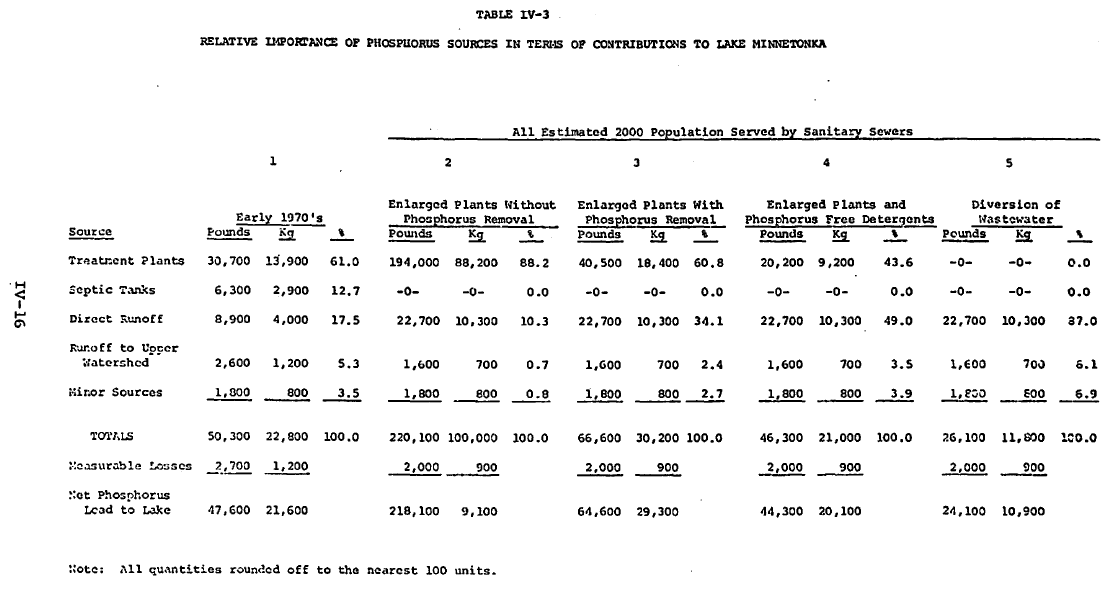
It was assumed for purposes of this estimate that the marshes will remove the same percentage of phosphorus from treatment plant effluent as they were during the study year. with greatly increased loadings as shown in column 2 of Table IV-3, there will doubtless be a reduction in the percentage removal in the marshes. However, the basic assumptions underlying the second column have not been given serious consideration and are only presented for purposes of comparison. The third column of Table IV-3 presents a phosphorus budget for more reasonable assumptions: if plants exist in the watershed in the future, they will be provided with facilities to remove 90% of the incoming phosphorus within the plant.' It can be seen that the phosphorus load from the treatment plants is closer to the load during the study year. Phosphorus removal by marshes in these circumstances should equal that estimated for the study year.
There are two alternatives to be considered for their effectiveness at reducing the phosphorus input to the lake. It is assumed for both alternatives that all future dwellings will be connected to sewage collection systems. For the first alternative it was assumed that treatment plants will be expanded to adequately treat the increased loading they will receive, and in addition that those plants will be modified or built to remove 90% of the phosphorus they receive. For the second alternative it was assumed that the collected sewage will be intercepted, removed from the Lake Minnetonka drainage basin, and treated for discharge near the Minnesota River.
The first alternative has the advantage of providing the maximum hydrologic protection of the lake. The second alternative has the advantage of providing maximum biologic protection of the lake.
The phosphorus concentration of sewage entering the treatment plants in the watershed is typically 13 mg/l. Approximately half of this is derived from domestic wastes and half from detergents. If it is assumed that 90% of the phosphorus is removed in the plant and 15% from the effluent in the effluent polishing pond
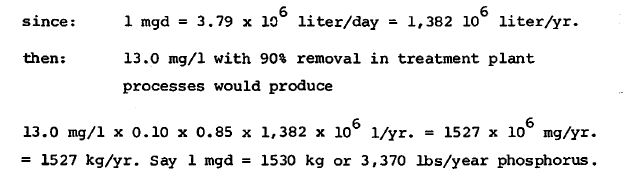
Thus, Table IV-4 shows that the projected flow in 2000 of 19.4 mgd will release approximately 65,400 pounds of phosphorus per year to the watershed (40,500 lbs. to the lake itself) from the improved treatment plants. If it can be assumed that the phosphorus content of detergents (source of approximately half of the phosphorus entering treatment plants) will be removed by the year 2000, these figures could be halved to 32,700 and 20,200 pounds respectively.
In Table IV-3, column 1 shows that of the estimated total of 50,300 pounds of phosphorus entering the lake annually, the existing treatment plants contribute an estimated 30,700 pounds. Column 2 shows that if the dwellings presently using septic tanks are connected to collection systems and all the future population growth is connected to collection systems for treatment at plants which do not employ advanced waste treatment, the total amount of phosphorus entering the lake may reach over 200,000 pounds annually by the year 2000. As shown in column 3, if the treatment plants are provided with facilities to remove 90% of the phosphorus, then the total amount of phosphorus entering the lake is expected to be about 67,000 pounds per year. Removal of phosphates from detergents appears to be a likely future development, although there is some question about the acceptability of the current leading contender as a substitute. If the removal of phosphates from detergents is realized and treatment plants remove 90% of the phosphorus reaching them, then as shown in column 4, it is anticipated that the total amount of phosphorus entering the lake in the year 2000 will be about 46,000 pounds per year. This is slightly less than the estimated current load on the lake of 50,300 pounds annually.
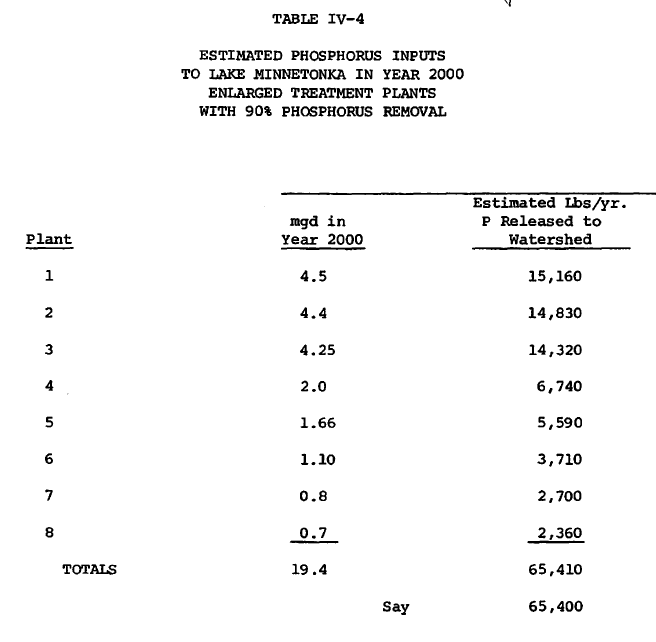
It is estimated that 62% of the phosphorus released by treatment plants reaches the lake. Therefore the predicted load on the lake is 0.62 x 65,400 = 40,500 pounds. Allowing 50% reduction due to removal of phosphates from detergents, then the amount released to the watershed would be about 32,700 pounds and about 20,200') pounds would reach the lake.
The alternate solution is to divert the waste out of the watershed completely. Column 5 of Table IV-3 indicates that by removing the wastewater from the watershed, the phosphorus input expected in 2000 is on the order of 26,100 pounds per year - approximately 54% of the present load. This input would be independent of the phosphorus content of detergents.
The data tabulated in Table IV-3 serve to emphasize the ever increasing magnitude and importance of direct runoff to the lake. This quantity has been estimated from data reported by other investigators for phosphorus contributions from urbanized land. Natural drainage ways and the marshes that they flow through before reaching Lake Minnetonka have been found to contribute less phosphorus to the lake than would be expected from the results of other investigators.