


Chapter V NUTRIENT-ALGAL RELATIONSHIP
One of the major objectives of these investigations was the determination of the relationships between the nutrient input to the lake, the nutrient content of the lake resulting from the nutrient input, and the production of algae resulting from the nutrient content. These relationships are used to predict, from estimated future inputs, the future phosphorus content of the lake, and, from the future phosphorus , content, the future algal growths.
The nutrient input can be expressed as pounds or tons or metric tons (1000 kg) of nutrient added to the lake each year. The nutrient input to the lake will, over a period of time, result in a nutrient content of the lake in equilibrium with that input. The nutrient content of the lake could be expressed as the total amount contained in the lake, again as pounds or metric tons, or it could be expressed as an average concentration, such as mg/l or mg/m3.
The investigations conducted by the Limnological Research Center of the University of Minnesota [Lake Minnetonka: Nutrients, Nutrient Abatement, and the Photosynthetic System of the Phytoplankton", Robert o. Megard, December 1970, Interim Report No.7, Limnological Research Center, University of Minnesota, Minneapolis, Minnesota 55455. This report is available directly from the Limnological Research Center, and includes data collected with the support of the U.S. Dept. of Interior and the Minnesota Resources Commission.] for this study indicate that during the warm summer months when problems arise with algae in Lake Minnetonka, phosphorus is the key element which controls their growth. L:n.at is, the algae grow to the extent allowed by phosphorus, and more sunlight, warmer water, more nitrates, more carbon dioxide, or more of any other essential element would not significantly increase the amount of algae in the lake.
Phosphorus has not been universally found to be the key element controlling the growth of algae. Carbon, which is available to algae as 002, has been found to be the key element in some regions of the country. The water in those areas is generally softer and richer in nitrogen and phosphorus than the water of Lake Minnetonka. Hardness in surface waters is frequently associated with carbonates (C03), and the carbonates will be in a state of equilibrium with CO 2 dissolved in the water. If CO 2 is removed through photosynthetic incorporation in cell material, it can be replaced by dissociation of the carbonates. Lake Minnetonka has naturally hard water because of the chemistry of the surrounding region, and therefore it is not surprising that carbon is available in excess of the needs of the algae.
W. T. Edmondson writing in "Science" for 14 August 1970 conunents on the response of Lake Washington (near Seattle) following the diversion of sewage from the lake. Diversion of sewage began in 1962, but facilities existed for the diversion of only about 25% of the sewage then. About 99% was diverted by March 1967 and final diversion took place in February 1968.
Edmondson reported that the phosphorus content of the particulate matter during the sununer corresponded well with the concentration of dissolved phosphate the previous winter. The concentrations of phosphorus in the lake declined steadily from 1963 through 1969, the latest date reported. The algae, as measured by the concentrations of chlorophyll, showed a decline during that same period of the same order of magnitude. Carbon dioxide remained more or less constant following a decline during the first year to about 70% of the starting concentration.
The studies by the Limnological Research Center indicate that \. nitrogen and phosphorus may both be limiting in Lake Minnetonka during a short time in early summer. However, the algae are not near as numerous during that portion of the year, and they do not constitute as severe a problem. It is felt that significant reduction of phosphorus in the lake may also aid in limiting the growth during the earlier portion of the year, since the dependence on nitrogenous compounds is not as pronounced as the dependance on phosphorus. Accordingly, the main goal of this study has been the control of phosphorus and the assessment of the efficacy of phosphorus control.
Input - Content Relationship
In order to assess the affect of reduced phosphorus loading of the lake on the growth rate of algae in the lake it is first necessary to assess the relationship between the lake's annual phosphorus input and its phosphorus content. This relationship has been estimated from present loadings and present contents and the relationship has been corroborated by use of data from the 1930's and by use of data for different locations within the lake.
Nutrient Input
In Chapter IV-Nutrient Budget, the annual phosphorus input for the period June 1969 through May 1970 is estimated to be 50,300 pounds or 22.8 metric tons (Table IV-2). Schoell and Madson in their "Report on Bacteriological and Chemical Sampling of Lake Minnetonka 1966-67 estimated that the total annual phosphorus input to the lake from June 1966 through May 1967 was 50,590 pounds or 23.0 metric tons.
While there are differences in the way the two estimates were derived, the indication is that the annual phosphorus input has been moderately uniform for the past 4 to 5 years. From Table IV-2, the phosphorus input to the lower lake is estimated at 25,530 pounds. The lower lake may receive on additional 3000 pounds from septic tank drainage, and perhaps 15 pounds from recreational use of the lake, for a total of 28,545 pounds or 12.9 metric tons.
Nutrient Content
The phosphorus content during the study year flUctuated from a high of 3S.7 tons to a low of lS.7 tons and the mean was 25.3. For the Lower Lake, and which contains some SO% of the total volume of the lake, and which hydrologically is essentially distinct from the remainder of the lake, the mean content for the period April 1968 to May 1969 was 13.4 metric tons.
Nutrient Losses
Most of the phosphorus which enters the lake appears to be removed i by deposition. In Chapter IV it is shown that about five percent of the phosphorus added to the lake is removed by stream flow and fish removal.
Detention Time
The phosphorus content of Lake Minnetonka for the last few years have been found to be relatively constant at 25.3 metric tons, while the input has been estimated at 22.9 metric tons per year. Therefore, the theoretical mean residence time would be 25.3 divided by 22.9 or 1.1 years.
For the lower lake alone, the rate of input during the study year, including half of the estimated septic tank phosphorus contribution to the lake, was on the order of 12.9 metric tons per year while the mean phosphorus content was on the order of 13.4 metric tons. Therefore the mean theoretical detention time for the lower lake is 1.04 years.
The question now arises, is the theoretical detention time a constant for all rates of input? The data available is limited, but suggests that it is not. Halsted Bay for example, is much smaller than the lower lake, and has a mean phosphorus content of 0.8 metric tons, while it received about 1.0 metric ton of phosphorus from Six Mile Creek. This indicates that the mean phosphorus detention time for Halsted Bay is on the order of 0.8 year, say 9-1/2 months. Another comparison can be made for the lower lake. Assuming that the relationships found for this study between algae and the concentrations of phosphorus would have held 30 years ago, an estimate of the phosphorus content of the the level of pH normally encountered in the lake, the reaction does not occur repidly enough to be considered economical for use in a treatment plant. However, the same reaction will occur at a lower pH, but more slowly. Since the growth of algae raises the pH by removing carbon dioxide from the water, the growth of algae while dependant on phosphorus, helps to remove phosphorus.
As the phosphorus content declines, the algal growth declines, the pH is not raised as high, and the rate of phosphorus removal \ declines, also. There is thus a theoretical basis for supposing that \ the detention time of the phosphorus will increase when the phosphorus ~concentration decreases.
A discussion of the rate at which the lake will approach a new steady state is given in Appendix B. It was concluded that the new steady would be approached very closely within three to five years.
Future Phosphorus Content
Following diversion of wastewater from the watershed, it is anticipated that the phosphorus input to the lake will decrease markedly. Table V-I was prepared from Tables IV-2 and IV-3. The column for the present input includes a distribution of the estimated septic tank phosphorus inputs. It can be seen that because of the locations of population concentrations and wastewater treatment plants, the most dramatic decrease in phosphorus input will occur in the lower lake.
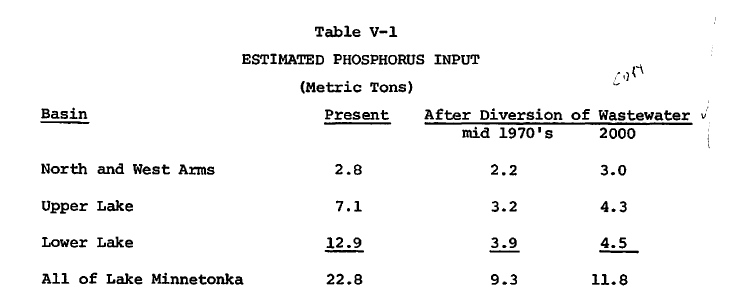
The future inputs of phosphorus lead to the conclusion that the phosphorus content of the entire lake in the year 2000 may be on the order of 23.6 metric tons. Of that amount, some 9 metric tons may be in the Lower Lake.
The volume of the entire lake is 402 million m3. Therefore, the future concentration of phosphorus may be 23.6 x 10⁹ mg 402 x 109 1 = 0.059 say, 0.06 mg/l. The volume of the Lower Lake is 216 x 106m 3 , and the expected future concentration of phosphorus in the Lower Lake may be 9 x 10⁹ mg ~ 216 x 109 1 = 0.042 say, 0.04 mg/l.
Interpretation of Results
Phosphorus Concentration
The investigations of the Limnological Research Center for this study lead to the conclusion that ar:;l growth during the summer is limited by phosphorus concentrations. This relationship"holds for phosphorus concentrations between 0.045 and 0.200 mg/l. When the concentration of phosphorus f-al,ls below 0.045 mg/l, the algal productivity seems to decline more rapidly. J
From the anticipated average values of 0.06 mg/l for the entire lake and 0.04 mg/l for the lower lake, algal concentrations can be estimated qualitatively from the data collected during the past years. The anticipated phosphorus concentrations are about the same as those found during 1969 and 1970 in Carman Bay. It can therefore be expected that algal concentrations in the future will closely parallel those found at Carman Bay recently.
Carman Bay at the present supports less photosynthesis than any of the other basins of Lake Minnetonka. The Limnological Research Center reports (Fig. 21 p. 73 in "Lake Minnetonka: Nutrients, Nutrient Abatement, and the Photosynthetic System of the Phytoplankton", Robert O. Megard, December, 1970, Interim Report No.7, Limnological Research Center, University of Minnesota, Minneapolis, Minnesota 55455.) that Carman Bay has an average gross photosynthesis of about 10 25 grams carbon/square meter/day, whereas the other basins are all above 1.9 g C/m2/day. Christmas Lake for comparison has an average photosynthetic production of about 0.8 g C/m2/day.
Areal Loading
The input to the lake can also be compared with other lakes on the basis of areal loading. The entire lake has an area of 58.6 x 10 6 m2 • The estimated phosphorus input to the lake with diversion of wastewater is 11.8 x 10⁶ g/yr in the year 2000. The areal loading will then be 262 11.8 : 58.6 = 0.2 g/m lyre The lower lake alone has an area of 26.2 x 10 m • The estimated phosphorus input to the lower lake of 4.5 x 10 6 g/yr will result in an areal load of 4.5 : 26.2 = 0.17 g/m2/yr.
In a similar fashion, areal loadings were computed for the present and for the near future following wastewater diversion. It was found that for the lower lake, the areal loading are 0.49 g/m2/yr and 0.15 g/m 2 /yr at the present and in the near future respectively. For the entire lake, the areal loadings were found to be 0.39 g/m2/yr and 0.16 g/m2/yr at the present and in the" future respectively.
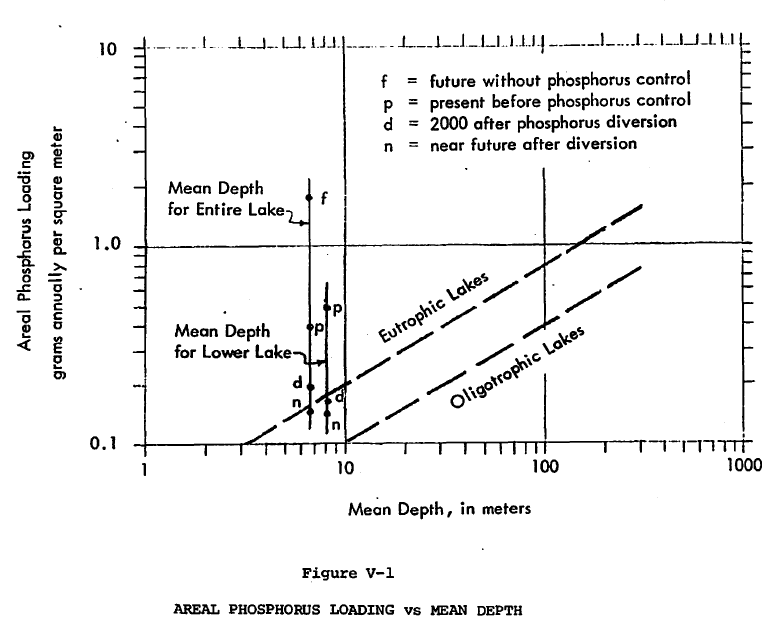
The mean depth for the entire lake is reported to be 6.9 meters and the mean depth for the lower lake is 8.3 meters.Y
The areal loadings were plotted against their respective mean depths Fiqure V-I. Two lines demarcate the approximate limit Vollenweider found for oligotrophic lakes and for lakes which were eutrophic. Vollenweider's data came from 15 lakes, all in the United States and Europe. As you can see, the areal loading for Lake Minnetonka and for the lower lake suggest that the lake will continue to border on being an eutrophic lake.
Vollenweiderl's parameter is independent of the residence time of phosphorus in the Lake, but is only a function of the annual input to the lake, the area of the lake, and the mean depth of the Lake. If the relationship he has indicated should apply to Lake Minnetonka, minimizing the phosphorus input to the lake will result in substantial benefit to the lake.
It must be emphasized that Lake Minnetonka is actually composed of a group of lakes. There is little exchange of water between the various basins, and therefore very little nutrient exchange between basins. Therefore, the management of Lake Minnetonka to achieve an improvement in water quality must consist of the management of the several major basins.
The diversion of wastewater from the watershed will have a marked effect on the lower lake, Cooks Bay, and Crystal Bay because of the locations of treatment plants. Improvement of the waters of Halsted Bay, Harrison Bay, Maxwell Bay, and other basins which do not receive wastewater directly must not be expected without additional measures protection of these basins is dependant on reducing the nutrient content of land runoff. This can be achieved in part by preserving the marshes and routing strom drainage through the marshes to utilize their nutrient trapping capacity.